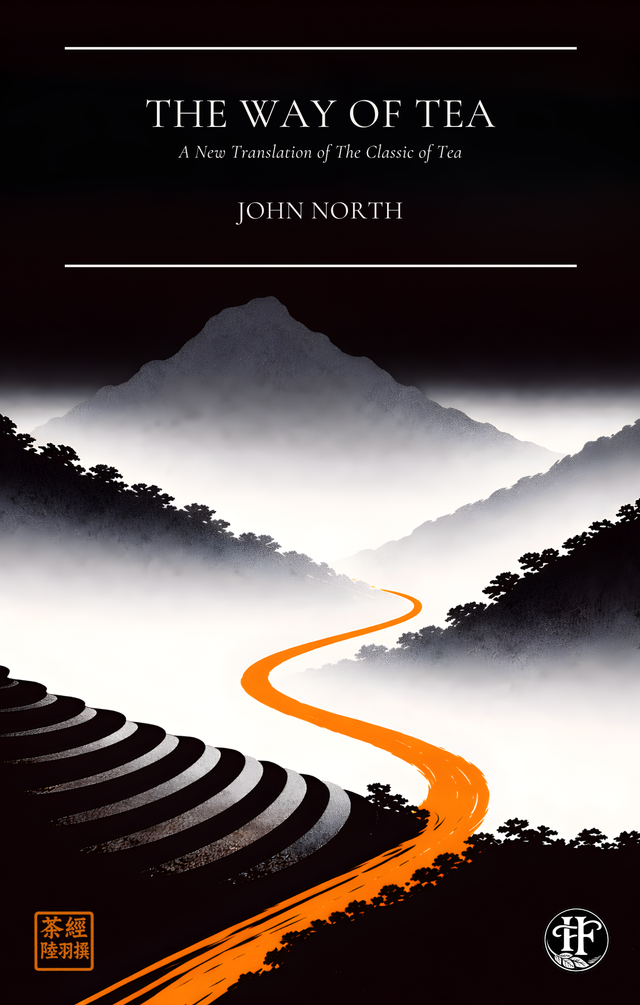
Introducing The Way of Tea: A New Translation of The Classic of Tea by John North
A dream of the hills,
bursting into leaf:
trees like bamboo,
vast in the mountains;
flowers of white rose,
the waking mist: cha,
jia, she, ming, chuan —
it is called tea upon the slopes.
A dream of the south,
tea loves the sandstone,
weathered shale, phyllite,
slate of Wuliang;
hates the opaque clay
of a long life left
unexamined, lost
in dark’s stagnation.
Come to the mountain,
learn the tea’s stillness,
its frugal virtue —
elixir of life
grows like ginseng,
amrita, sweet dew —
take just one sip…
it is spring in Yunnan.
From John North’s new translation of The Classic of Tea.
The Classic of Tea, or Chájīng, is a Chinese text over a thousand years old. Written by the 8th Century scholar Lù Yǔ, it is the earliest known extant – and perhaps the most famous – book about tea. Short, poetic, and utterly ancient, it gathers the foundations of tea culture into a single work. This new translation, John's first chapbook from our small press, isn't a technical translation but a poetic reimagining of that classic: a retelling which draws in part on literal translations of the Chinese, and in part on free interpretation.
John North studied poetry under John McAuliffe and Vona Groarke at the University of Manchester, where he received an MA with Distinction. His poems have appeared in a number of leading journals and anthologies, though he was largely absent from publication for several years before returning to writing more recently. This is, however, his first attempt at translating 8th-century Chinese! He began work on it around the same time he fell in love with Yunnan tea: an ancient, noble leaf which, after being smuggled to India by the British East India Company, became the forebear of much of what the world now knows as tea. He writes: “I discovered the Chájīng whilst researching Chinese tea culture. I found a digital copy of the original, began reading through modern translation tools and immediately thought… this would make great poetry… it already is great poetry! Lù Yǔ has a powerful voice, and his descriptions of things as simple as water boiling in a kettle are absolutely magical. So I started playing around and before I knew it I had worked through half the text in one sitting and had the beginnings of a manuscript. I’ve always preferred the chapbook and independent side of poetry, so I thought it might be the perfect opportunity for our fledgling small press to do something interesting.”
It isn’t uncommon for poets to render translations of texts from languages, dead or alive, that they aren’t fluent in. Poetic translation aims not to create an exact technical translation, but to honour the feeling and sense of original texts, to be a record of a personal conversation between one writer and another over a distance of time and space.
John writes: “My translation uses another form of “translation” in itself, as this retelling is written in an English approximation of juéjù (絕句), a Chinese poetic form that flourished in the Tang dynasty – the very age of the Chájīng. Juéjù consists of a quatrain, written either in five characters or seven characters per line. It is known for its compression, vivid images, and the subtle turn of thought that often appears in the third line. In its time, it was considered one of the finest tests of a poet’s skill: to say little, yet suggest a world.
Because English cannot mirror the compactness of Chinese characters, or the intricacy of tonal patterns, I have used an approximate form inspired by juéjù – four lines each of five syllables, more or less, and no rhyme scheme – echoing some of the shape of classical juéjù while remaining natural in English. This gives each stanza a measured pace, a sense of restraint, and enough space for image and meaning to settle. It resembles haiku in brevity, though it comes from a different lineage.
It has been a real privilege to combine two of the things I am passionate about here. And I’m delighted to have been able to add a poetic translation to the really incredibly small pool of English language translations of The Classic of Tea. If more people have the chance to learn something about the history of our nation’s favourite beverage because of it, all the better. This is something we essentially begged, stole and borrowed from China, and have done remarkably little to understand the origins of.”